


HAVVIS Men's Performance Underwear Boxer Briefs Soft Comfortable Bamboo Viscose Underwear for Men Multipack(Boxer Briefs : A01 - 9 Pack)
$ 27.51
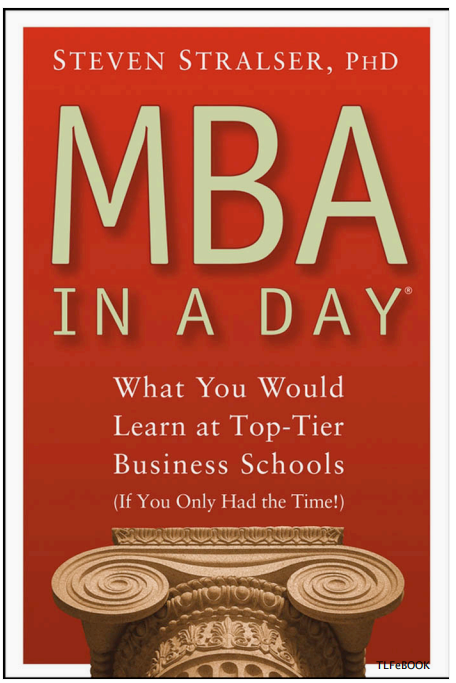
MBA in a Day ebook
$ 39.01
Product Description Of course you can’t get an MBA degree in a day—ask anyonewho has put in the months and years needed to accomplishthis challenging and rewarding achievement—but this bookis where you will find, in basic, easy-to-understand language, MBAconcepts and principles that are presented in the gold standard ofbusiness education throughout the world—the master of business administration. The story behind this book comes from my years teaching in afull-time MBA program where I began to notice something I found very interesting. Every semester, in addition to the traditional MBAstudents who had taken time off from their corporate life to enroll inthe MBA program, I would find one or two students who were clearly“outliers” to these mainstream corporate types—for example, a physician, an attorney, an executive director from a nonprofit organization,or a small business owner or entrepreneur. It did not take long to realize this trend was an indicator of an underlying interest, and need, for these well-educated professionals— well trained in the education of their profession—to learn about the“business side” of their professional lives. These non-business-trained professionals wanted to fill a gap andlearn business principles and concepts needed in their professional practices but not taught in medical schools or other professionalschools such as law, engineering, architecture, veterinary, or other highly specialized training programs. I also realized that for every physician, attorney, architect, or entrepreneur who can take the time to enroll in an MBA program, there are many more who are pressed for time and focused on the day-to-daychallenges of running a successful practice, operating a small business,or launching a new venture but who would benefit from learning theessential principles and concepts found in the coursework of an MBA program. It is for these successful—albeit time-sensitive—professionals that this book is written. In this book, you will learn the fundamental concepts and principles that full-time MBA students learn and that also have applica ability to professional services providers, small business owners, andentrepreneurs as well as corporations and industry. These principlesand concepts are not industry or profession specific—they are classic, strategic, and essential in performing in today’s complex economic environment. The book begins with Section I: People, Management, and Policy,which focuses on the human side of business. Chapter 1, “Human Resources,” explores how human assets are critical to success and competitive advantage. Chapter 2, “Organizational Behavior,” explores thedynamics of how people work together in an organizational setting. Chapter 3, “Leadership and Team Building,” explores the differencesbetween managing and leading and presents concepts behind the effective use of teams as a means to achieve organizational goals. Chapter 4,“Ethics,” focuses on the complexities and issues that managers face indoing the right thing in an increasingly ambiguous and uncertain organizational environment. Chapter 5, “Negotiation,” presents essentialprocesses for navigating through the dynamics of conflict and agreement, providing a useful understanding of how this subject is criticalto managers who must negotiate to some degree, on several levels,every day. Section II: Money: Economics, Finance, and Accounting, focuseson the concepts and principles we associate with the financial side ofan organization and its economic context. Chapter 6, “Accounting andFinance,” explores the way we keep score in business, providing theessentials of accounting systems and financial statements. Chapter 7,“International, National, and Local Economics,” provides a vocabularyof economic fundamentals to understand how nations, corporations,and individuals behave in markets to efficiently apply and allocatescarce resources and make their way through global economic systems. Section III: Markets and Strategy explores the way organizationsread, adapt, and communicate with their customers, competitors, and constituencies. In Chapter 8, “Marketing, Strategy, and CompetitiveAnalysis,” we review how organizations analyze their industry and their competition and then develop the way they communicate with their target customers. Chapter 9, “Advertising and Promotion,” looks at thespecifics of companies’ communication with customers and clients. Chapter 10, “Communications and Presentations,” presents principlesand concepts about an increasingly important part of managing a business today—how to present our ideas and communicate effectively. Section IV: Systems and Processes explores the key areas for organizations to implement their strategies and maintain competitivenessand sustainability. Chapter 11, “Project Management,” explains howmanagers can tackle specific projects from start to finish and efficientlymanage them. In Chapter 12, “Management Information Systems,” we explore the increasingly important essentials of today’s cyber-environ ment and how technology can be harnessed to achieve organizationalexcellence. Chapter 13, “E-Commerce and Uses of the World WideWeb,” explores the use of the Web both as a means to communicate with customers, clients, and constituencies and also as a tool for organizational efficiency and productivity. And finally, in a world where quality isthe key driver to market success and sustainability, Chapter 14, “QualityManagement Systems,” explores the concepts and principles of developing a culture and organizational purpose focused on quality.